


Publish date: 2026-06-29
In the day-to-day procurement of precision components, many engineers and buyers face the same question: both are advanced ceramics, so why is silicon carbide (SiC) often quoted at several times — or even over ten times — the price of alumina (Al₂O₃)?
The answer is straightforward: its "cost" is a direct reflection of its "capability."
Silicon carbide ceramics approach the hardness of diamond, withstand sustained temperatures above 1600°C, and offer excellent thermal shock resistance and corrosion resistance. However, these performance advantages are built on high-barrier SiC ceramic manufacturing processes.
This article will help you understand:
1. What exactly makes SiC ceramics expensive?
2. Where can SiC ceramics be used?
3. How to choose the right SiC ceramic components and manufacturer?
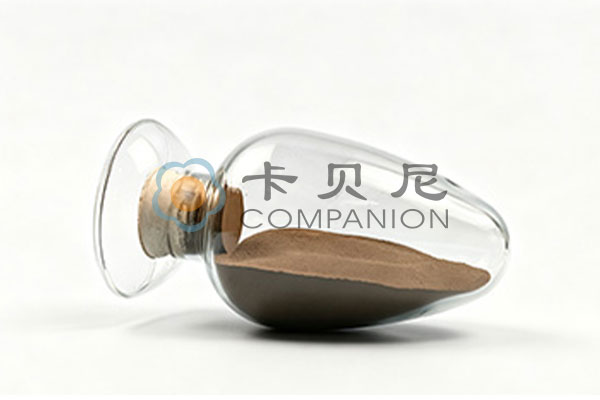
Factor 1: High-Purity Raw Materials
High-performance SiC ceramics require high-purity SiC powders with tightly controlled impurity levels. Producing high-purity powders costs more, which directly raises the baseline material cost of SiC ceramics.
 |
|
SiC Granulation Powder |
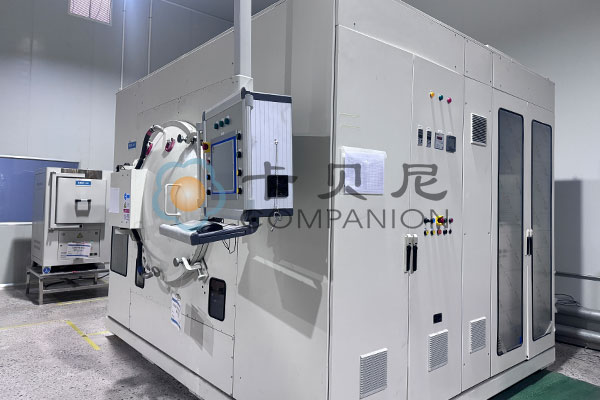
Factor 2: High-Temperature Sintering
To achieve a dense, low-porosity microstructure, high-purity SiC typically requires sintering at temperatures above 2000°C. During this process, the material undergoes irreversible shrinkage. Without precise process control, large or thin-walled parts are highly prone to warping and distortion.
 |
|
High-Temperature Sintering Furnace |
Factor 3: Precision Machining
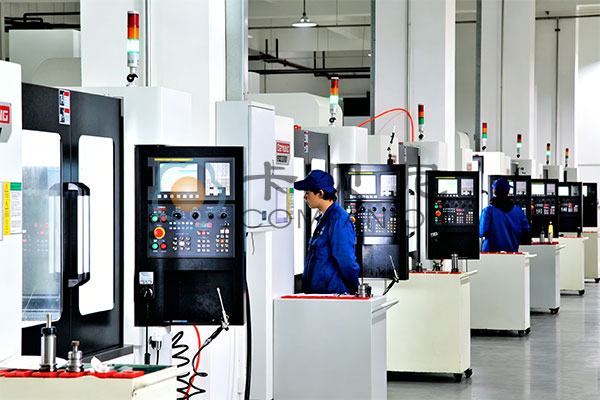
SiC combines high hardness with brittleness, making it widely recognized as one of the most challenging materials in precision machining. Standard carbide tooling cannot meet processing requirements; diamond grinding wheels or specialized laser machining are typically needed. This creates two immediate problems: long machining times (days to weeks) and rapid tool wear.
Furthermore, SiC is inherently brittle. When machining micro-holes, deep grooves, or thin-walled structures, inadequate process control can lead to edge chipping or cracking. Yield rates have a substantial impact on the final unit cost of the product.
 |
|
Companion CNC Precision Machining Workshop |
Factor 4: Cost Differences Across SiC Process Routes
SiC ceramic production encompasses several mainstream process routes, each with significant differences in cost and performance:
| Process Route | Relative Cost | Key Characteristics |
|---|---|---|
| Reaction Sintering | Lower | Near-net shape, but contains free silicon; limited high-temperature performance |
| Pressureless Sintering | Baseline (High) | Higher purity, good temperature resistance, but high shrinkage rate; requires precision machining |
| Hot Press Sintering | Higher | Higher density, but limited geometries and low production efficiency |
| CVD | Highest | High purity, excellent performance, but extremely slow growth rate and massive equipment investment |
Different processes suit different applications. Selecting the wrong one leads to unnecessary costs — a critical consideration during procurement.
Factor 5: High-Precision Requirements
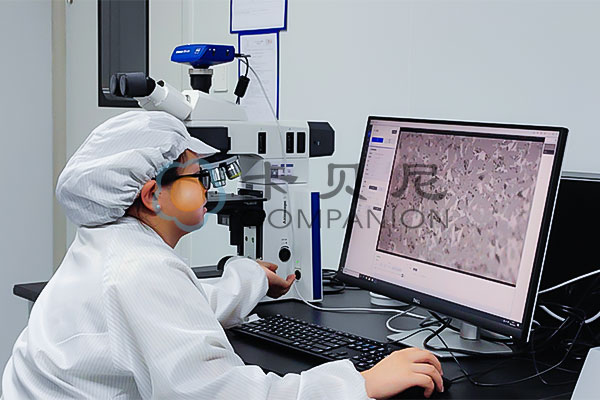
In high-end applications such as electronics engineering and precision manufacturing, SiC ceramic structural components often require micron-level flatness, nanometer-level surface roughness, and high hardness. This demands high-precision equipment, cleanroom environments, and sophisticated inspection protocols. The number of manufacturers capable of stable volume production and delivery is limited, and this market scarcity further drives up product prices.
 |
|
Companion Quality Inspection in Progress |
So which ceramic should you choose? The table below provides a side-by-side comparison.
If the components you currently use exhibit any of the following issues, it indicates that existing materials may have reached their performance limits — and it may be time to evaluate whether SiC ceramics are a better fit.
| Issue | Typical Symptoms |
|---|---|
| Frequent Replacement | Replacement needed every 3–6 months, with downtime each time |
| Particle Contamination | Component shedding particles, leading to increased product scrap rates |
| High-Temperature Deformation / Cracking | Furnace tubes and support beams bending or cracking under high temperatures |
| Corrosion | Surface pitting in acidic, alkaline, or corrosive gas environments |
| Insufficient Thermal Conductivity | Existing materials dissipate heat too slowly, causing excessive workpiece temperatures or constrained process windows |
| Excessive Weight | Metal or other ceramic components are too heavy, affecting equipment dynamic response or energy consumption |
So why is SiC able to address these problems?
Silicon carbide (SiC) is a polycrystalline ceramic material with covalent bonding. It offers high hardness, good wear resistance and compressive strength, and excellent high-temperature performance. The specific characteristics of SiC ceramics are as follows:
| Property | Description |
|---|---|
| High Hardness | Mohs hardness of approximately 9.2–9.5, approaching diamond |
| High-Temperature Resistance | Long-term service at approximately 1600°C |
| Thermal Shock Resistance | Resists cracking under rapid heating and cooling |
| Corrosion Resistance | Stable against most acids, alkalis, and corrosive gases |
These combined performance strengths make SiC ceramics suitable for a broad range of applications, including electronics engineering, mechanical equipment, energy, and flat panel display. They maintain dimensional and mechanical stability even under demanding conditions, making SiC a high-performance critical material.
Microstructure has a decisive impact on ceramic performance:
• Premium Structure: Fine, uniform grains with high density; good corrosion resistance; lower risk of micro-crack initiation and propagation.
• Standard Structure: Coarse grains with low density and high porosity; susceptible to corrosion; more defects; prone to failure from micro-cracking.
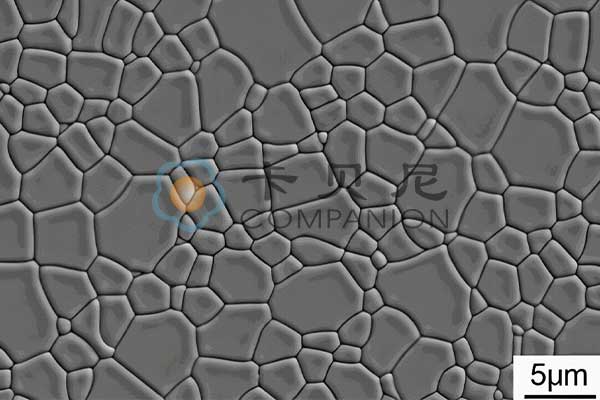 |
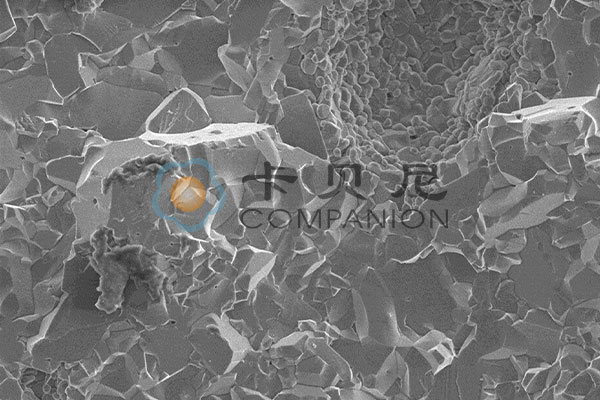 |
|
Companion SiC Ceramic: Premium Structure |
Standard SiC Ceramic: Conventional Structure |
Given these performance advantages, why is SiC so much more expensive than other advanced ceramics like alumina and zirconia?
| Comparison Item | Alumina (Al₂O₃) | Zirconia (ZrO₂) | Silicon Carbide (SiC) |
|---|---|---|---|
| Hardness | ~9 | ~8.5 | ~9.5 |
| Continuous Service Temperature | Moderate | Lower | Higher |
| Thermal Shock Resistance | Moderate | Moderate | Excellent |
| Acid & Alkali Corrosion Resistance | Moderate | Moderate | Excellent |
| Thermal Conductivity | Moderate | Lower | Higher |
| Unit Cost | Baseline (Low) | Moderate | Higher |
| Typical Service Life (Extreme Conditions) | Shorter | Moderate | Longer |
In general, alumina is sufficient for standard operating conditions. In extreme conditions, while SiC has a higher unit cost, its longer service life and reduced replacement frequency can result in a lower total cost of ownership.
If your application does require SiC, how should you choose among the options for different service conditions?
| Application Environment | Applicable Components | Key Selection Criteria |
|---|---|---|
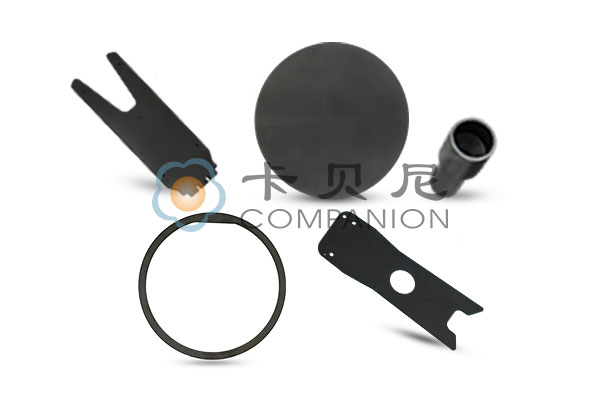
| Electronics Engineering | Vacuum Chucks, Robot Arms, Carrier Discs, ESD-Safe Chucks, Metallized Substrates | High flatness, low particle shedding, plasma corrosion resistance, support for metallization and ESD-safe processes |
| High-Temperature Heat Treatment | Furnace Tubes, Saggars, High-Temperature Carrier Paddles | Sustained temperature resistance, thermal shock resistance, high-temperature creep resistance |
| Chemical Corrosion Environments | Heat Exchanger Tubes, Seal Rings, Spray Nozzles | Corrosion resistance to aggressive media, high density, wear and erosion resistance |
| Precision Custom Components | Various Custom Structural Components, Non-Standard Precision Assemblies | Complex profile machining, high-precision tolerances, back-end finishing and treatment capabilities |
Given the constraints of SiC manufacturing processes and raw materials, prices are unlikely to drop to alumina levels. However, choosing a reliable SiC manufacturer can effectively reduce total cost of ownership through mature, full-chain process optimization — delivering better product durability, reduced downtime frequency, and steadily improving production yield, achieving cost efficiency across the entire product lifecycle. Taking Companion as an example, process synergy optimization is realized in three key stages:
(1) Raw Material & Forming Stage: Reducing Post-Processing Losses
By combining a diverse range of high-purity powders with mature granulation processes, we optimize green body forming quality and sintering parameters at the front end. This brings the shape and dimensions of sintered blanks closer to final product requirements, reducing machining losses downstream. This approach is adaptable to a wide range of advanced ceramic materials.
(2) Precision Machining Capability: Improving Yield and Reducing Scrap
Drawing on years of deep expertise in hard and brittle materials, Companion has developed dedicated machine platforms and proprietary machining processes for various hard and brittle materials. We can perform high-precision machining of micro-holes, thin walls, and other complex structures, and we undertake custom production of both standard and non-standard products including rings, vacuum chucks, robot arms, and carrier discs. By leveraging mature process control to reduce edge chipping, cracking, and other defects, we help customers optimize per-unit production costs through improved yield.
(3) Structural Design Stage: Extending Service Life and Reducing Downtime
Through rationalized structural design, we improve component operating conditions and slow wear progression — delaying part aging in real-world application environments, reducing equipment downtime and replacement frequency, and enabling smoother, more stable production operations for our customers.
 |
The sophisticated manufacturing processes and stringent technical standards behind SiC ceramics form the core barrier to entry — and the foundation of their value. Choosing a specialized SiC manufacturer means choosing yield assurance and reliable delivery. If you are facing challenges with short component service life or insufficient machining precision, contact Companion to obtain a customized SiC ceramic component solution.






 LANGUAGE
 WhatsApp